

Several findings used in sales training did not survive replication. The decoy effect mostly disappears with real products. The hotel-towel social proof gap is nearer six points than nine. The jam study’s effect averages near zero across about fifty studies. The scarcity study most often cited never showed that people pay more.
What “failed to replicate” actually means
Four quite different things get filed under the same phrase, and most pages that list “debunked” psychology treat them as one. The distinction is the whole of the practical question, because only one of the four means the effect is not there.
| Outcome | What it means | What to do with it |
|---|---|---|
| The effect shrank | Later and larger studies find it, but smaller than the famous number. | Keep using it. Stop quoting the original figure. |
| It held only under conditions | It appears reliably in one setting and not in another, and the boundary is known. | Check you are inside the boundary before you rely on it. |
| It mostly vanished | Well-powered attempts with realistic materials find little or nothing. | Stop building a method on it. |
| It was never testable | The evidence is proprietary and the raw data has never been released. | Treat it as experience, not as research. |
Three of those four still leave you with something usable. Calling all of them “debunked” throws away working knowledge; calling none of them that keeps dead findings in circulation. The list below sorts them.
The findings that did not survive as stated
Each row gives the version in circulation, then what happened when other researchers tried to reproduce it.
| Finding | The version in circulation | What the replication evidence says |
|---|---|---|
| Decoy effect | Adding a deliberately worse third option pushes buyers to the one you want. | Frederick, Lee & Baskin ran 38 studies (JMR, 2014): with real products and experienced attributes it did not appear, and one bottled-water study found the reverse. Yang & Lynn made 91 attempts across 23 product classes; 11 produced a reliable effect. |
| Hotel towel social proof | Telling guests that most other guests reuse their towels lifts reuse by nine points. | Bohner & Schlüter (PLOS ONE, 2014, N=724 and N=204) found the norm message no better than a plain environmental appeal. A Bayesian synthesis of seven experiments supports a real effect of about six points. |
| The jam display | Twenty-four jams, 3% bought. Six jams, 30% bought. | A meta-analysis of about fifty studies put the mean effect of assortment size near zero. Chernev and colleagues (2015, 99 observations, N=7,202) restored it as conditional on four moderators. |
| Scarcity raises what people pay | The two-cookie jar is wanted more than the ten-cookie jar, so scarcity lifts price. | In Worchel, Lee & Adewole (1975) the scarce jar was rated more desirable, but the price measure was not significant. Desire moved; willingness to pay was not shown to. |
| Closing technique research | An analysis of 35,000 sales calls proves that closing techniques hurt large sales. | The Huthwaite corpus is proprietary consulting research. It was never peer reviewed and the raw data has never been released, so it cannot be checked by anyone outside the firm. |
| Price-first framing | Showing the price before the product makes people buy more. | Karmarkar, Shiv & Knutson (JMR, 2015) found price-first shifts valuation towards “is it worth it”. Purchase rates did not differ. |
| “Because” works on its own | Giving any reason, even an empty one, raises compliance. | In Langer, Blank & Chanowitz (1978) the empty reason worked for a five-page request (60% to 93%). At twenty pages it stopped working. |
Every study named on this page is one of thirty in The Fourth Bottle, each traced to the paper it came from. The full source table is public, and a complete chapter is free to read before you decide anything.
The five worth knowing in detail
The decoy effect is a laboratory phenomenon
It is the clearest case on the list, and the one most often taught as settled. Frederick, Lee and Baskin tested it across 38 studies published in the Journal of Marketing Research in 2014. When people tasted the drinks, touched the tissues or looked at photographs of the apartments, the effect was absent. It reappeared when every attribute was a number: picture quality rated 33% to 57% in one television study, and gone again the moment the same quality was shown as a photograph rather than a score.
Yang and Lynn reached the same place by a different route in the same year, with 91 attempts across 23 product classes and 73 decoyed choice sets. Eleven produced a reliable effect — fewer than their statistical power led them to expect. Describing the options in meaningful words, or showing them as pictures, cut the effect to chance.
The honest complication is that it has not been buried. Müller, Schliwa and Lehmann, also in 2014, ran a controlled replication on prize choices in competitions and found an effect of about 16% that held across demographic groups. Their argument is that the failures come from the choice setting rather than from the effect being unreal. So the defensible summary is narrow: it is real where everything is a number and the buyer is trading off two numeric attributes, and it is not something to build a pricing page around.
The hotel towel figure is about six points, not nine
Goldstein, Cialdini and Griskevicius reported 35.1% reuse against 44.1% in 2008, at p=.05. That nine-point gap is the number in every social proof deck since. Bohner and Schlüter then ran two German field experiments (N=724 and N=204) in which guests got a descriptive norm message, a standard environmental appeal, or nothing. Both messages beat no message. The norm message did not beat the ordinary appeal.
Scheibehenne, Jamil and Wagenmakers settled it in Psychological Science in 2016 by pooling seven experiments rather than counting wins and losses. The data came out roughly 37 times more likely under a real effect than under no effect. A 2017 re-analysis of the same seven experiments put the average at about six percentage points, with a credible interval from 2.5 to 9.5 — moving reuse from around 50% to around 56%.
This is the shape most of these stories take once someone does the arithmetic properly. The effect is real. It is roughly two thirds of the advertised size, and it is not larger than simply asking people politely.
The jam study was never the study you were told about
Iyengar and Lepper set up a tasting table with 24 jams and another with 6. The large display drew more people and sold to 3% of them; the small one drew fewer and sold to 30%. Scheibehenne, Greifeneder and Todd then gathered about fifty studies of assortment size in 2010 and found the mean effect close to zero.
The resolution came in 2015, when Chernev, Böckenholt and Goodman pooled 99 observations from 7,202 people and found four conditions that decide which way it goes: how complex the choice set is, how hard the task is, how uncertain the buyer’s preferences are, and what they came to do. Choice overload is real inside those conditions and absent outside them, which is why a supermarket aisle and a perfume counter behave differently.
Scarcity raises desire. It was never shown to raise price
The cookie jar study is cited for the claim that scarce things command more money. Worchel, Lee and Adewole found in 1975 that people rated cookies from a jar of two more desirable than the same cookies from a jar of ten. The study also measured what people would pay, and that measure was not significant.
The gap between wanting something more and paying more for it is exactly the gap a seller cares about, and the study most used to close it did not close it.
The most-cited evidence in professional selling cannot be checked
The research behind the best-known model of large-account selling is an analysis of around 35,000 sales calls by a consulting firm. Two of its findings are quoted constantly: that closing training raised success on low-value sales from 72% to 76% but dropped high-value sales from 42% to 33%, and that calls with many closing attempts converted at 37% against 70% for calls with few.
There is no reason to assume those numbers are wrong. There is also no way to find out. The work was never submitted to peer review, the raw data has never been released, and the published account is internally inconsistent about how long the study ran. That belongs in the fourth category above: experience worth taking seriously, not research you can lean on.
What still holds up
A page that only lists failures leaves a false impression of its own. These have been retested and survived, which is the reason they are worth more attention than the famous ones that did not.
| Finding | Evidence | Standing |
|---|---|---|
| Free is not just cheaper | Shampanier, Mazar & Ariely (2007): a 1¢ chocolate against a 15¢ one splits 27/73; making the cheap one free inverts the split. | Robust |
| Reciprocity after an unsolicited favour | Regan (1971): raffle purchases rose from 25% to 58% after an unrequested can of Coke. | Robust |
| Visible effort raises satisfaction | Buell & Norton (2011), five experiments: people preferred a longer wait when the work was shown, with identical results. | Robust in its domain |
| Paying by card loosens the hand | Prelec & Simester (2001): card bids up to 100% higher than cash for real basketball tickets. | Direction replicates, size varies |
| A discount can make the product work worse | Shiv, Carmon & Ariely (2005): a discounted energy drink produced worse puzzle performance than the same drink at full price. | Conceptually replicated |
| A precise first number anchors harder | Mason and colleagues (2013), N=1,254: $5,015 reads as better informed than $5,000 and draws smaller counteroffers. | Extended by later work |
How to tell a durable finding from a fragile one
You will meet new claims faster than anyone can check them for you. Four questions sort most of them without reading a paper.
- Was it tested on something real? Effects that live in numeric specifications tend to die when the buyer can taste, touch or look at the thing.
- Is the famous number from the first study? First studies run small and report large. The later, duller number is usually the true one.
- Did the outcome measured match the outcome claimed? Desire, attention and valuation are not purchases, and several classics measured one and are quoted for the other.
- Can anyone outside the authors check it? Proprietary data that has never been released is not evidence you can build on, however large the sample sounds.
Where this page stops
This is a map of the evidence, not a verdict on any technique. A finding that shrank by a third can still decide a close sale, and a finding that holds up in a laboratory can still be useless in your market. Most of the research here was run in Western countries, much of it on students, and almost none of it on the specific thing you sell.
Questions people ask
Which sales psychology study failed most clearly?
Does that mean the jam study was wrong?
Is social proof still worth using?
Why do sales books still quote the old numbers?
What does “failed to replicate” not mean?
Is the research behind SPIN Selling peer reviewed?
Which findings in this area are safest to rely on?

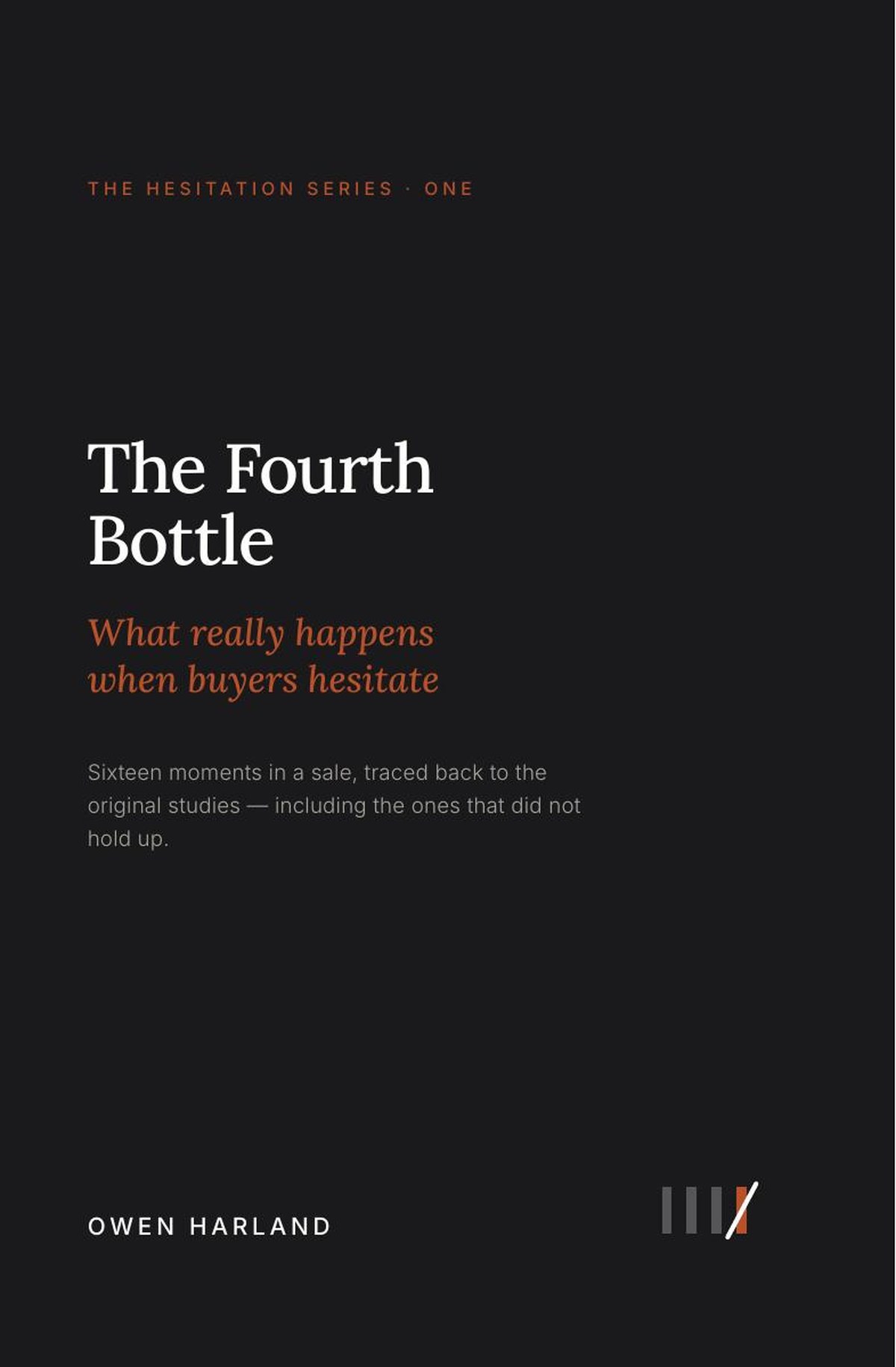
The Hesitation Series · Volume One
The Fourth Bottle
Thirty studies, each traced to the paper it came from and marked with what happened when someone tried to repeat it — including the ones on this page that did not survive.
Get the book — $19